New and Notable Marine Electronics
 Impressive marine-electronics technologies continue to debut ahead of the summer boating season.
Courtesy Avikus
Impressive marine-electronics technologies continue to debut ahead of the summer boating season.
Courtesy Avikus
Things drop each fall. For most people, this involves daylight hours or tree leaves, but for boaters, it’s when new marine electronics hit the market. Here’s some of the new equipment that stands ready to upgrade most boats for the 2026 cruising season.
AirmarAirmar’s dual-frequency 1-kW transducers, the B275MWHW and TM275MWHW, can help anglers improve piscatorial pursuits in depths to 1,300 feet. Each transducer operates on medium- (60 to 100 kHz) and high (150 to 250 kHz) frequencies, and each harnesses Airmar’s concave ceramic array. This yields beam widths of 57 to 73 degrees port and starboard, and about 16 degrees bow and stern when operating on medium frequencies. It’s 25-degree beam widths when pinging on high frequencies.
Both of these transducers can locate targets down to 500 feet in their high-frequency modes, or to 1,300 feet in medium-frequency modes. The B275MWHW has a bronze through-hull housing that includes a high-speed fairing block, while the transom-hung TM275MWHW uses a urethane housing and a stainless-steel bracket that adjusts to accommodate different transom angles up to 21 degrees.
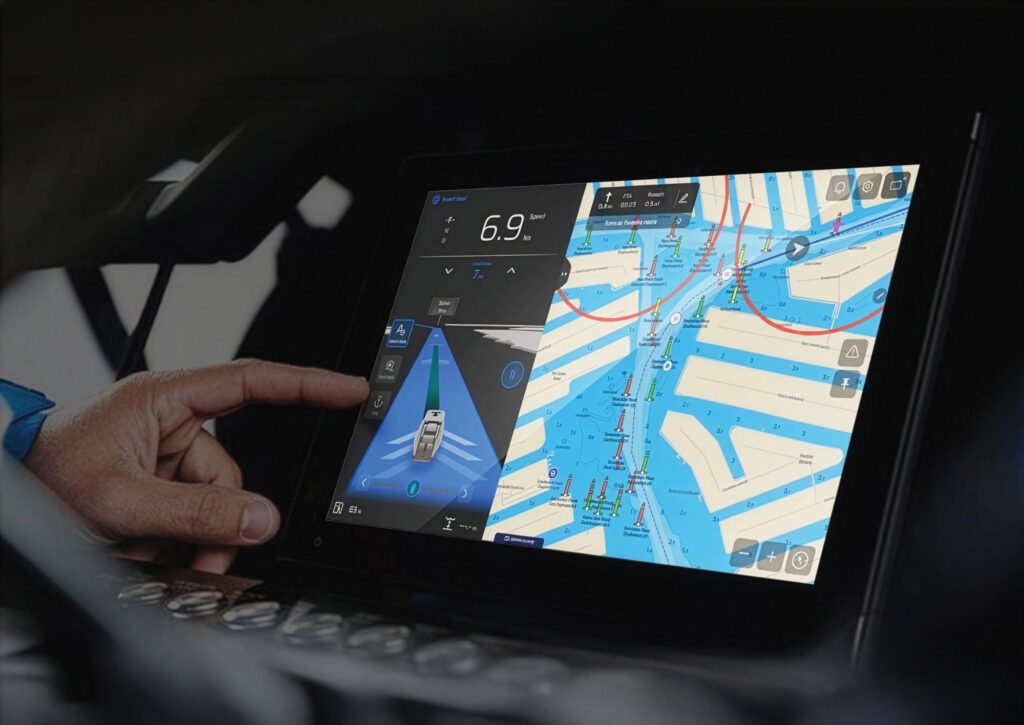
AvikusAutonomous vessel operations have been a holy grail for years, and Avikus has made big strides via its Neuboat Navi with Control. This smart system has autopilot control, collision avoidance, engine and steering control, object recognition and route planning.
Hardware-wise, Navi with Control bundles a 142-degree field-of-view camera and a LiDAR sensor with a 1,640-foot detection range into an IPX6-rated housing. These sensors share their data feeds with a camera conversion unit belowdecks and an object recognition unit. Together, these units leverage a kind of AI called machine vision to recognize threats.
An included Engine Gateway gives Navi with Control command over the vessel’s horsepower, and autopilot integration enables autonomous rudder control. The system’s automotive-style adaptive cruise control can match speed when following other vessels, and it can slow or stop as needed.
Digital YachtSafe navigation often hinges on accurate position fixes, and Digital Yacht’s OneFix yields highly accurate latitude and longitude information by way of a dual-band processor and a global navigation satellite system receiver. OneFix sensors ($480) can listen to signals from the BeiDou, Galileo, GPS and NavIC satellite constellations via the L1 and L5 bands to calculate position information, which purportedly often surpasses 1-meter accuracy. Users can optionally receive signals from Russia’s Glonass constellation, although this requires a second antenna.
OneFix sensors sport anti-spoofing algorithms that provide alerts if tomfoolery is detected, and they can output their position fixes to NMEA 0183 or NMEA 2000 networks, or to Wi-Fi for use with devices.
DockmateDon’t love helm-side docking? Dockmate Pro (from $14,990) gives users proportional control over a vessel’s engines. Users can control a yacht’s port and starboard engines separately, or simultaneously control two screws with single-digit input.
Each of the remote’s control levers has two independent channels for redundancy, and an accelerometer automatically curbs operations if the remote is dropped. The remote sports a sunlight-readable 1.3-inch LCD monochrome screen that gives at-a-glance access to alarm codes, setting configurations and status updates, while twin LEDs provide additional feedback.
Dockmate Pro is buoyant with IP67 water-ingress ratings, and has a range of up to 164 feet.
FLIRFLIR’s M460 and M560 are top-of-the-line, AI-powered multispectral maritime camera systems. The cameras’ ($120,000 – $265,000) three-axis gyrostabilized radomes each house a high-end thermal-imaging sensor, a 4K low-light camera, a laser rangefinder and an optional long-range (read: 6.5 nautical miles) laser spotlight. FLIR’s built-in AI Target Tracking uses an AI neural network to automatically detect and identify objects.
While the cameras’ sensor packages are similar, the M460 employs a long-wave infrared sensor with 5x optical zoom, while FLIR’s flagship M560 has a midwave infrared thermal sensor with 14x optical zoom. Both systems have FLIR’s Color Thermal Vision, which combines information from the systems’ low-light cameras with their thermal-imaging feeds to make thermally captured scenes easier to read and understand.
GarminFew words spark greater fear than “man overboard.” Garmin’s OnBoard ($500 for the base system and one tag; $150 for additional tags) is an MOB-detection and engine cutoff system that uses boater-carried (or worn) tags that are paired with the system’s GOS 10 Hub. That hub then is networked with a compatible Garmin multifunction display. If an MOB tag breaks its electronic contact with the GOS 10 Hub, the system triggers audible alarms and sets an MOB waypoint on the chartplotter.
OnBoard systems can monitor up to eight MOB tags and are compatible with all vessels with engine cutoff switches.
OceanLEDIt’s one thing to illuminate a vessel’s undercarriage, but it’s another thing to see real-time below-waterline video imagery. OceanLED’s Sports Colours Camera Edition series lets boaters do both by bundling a 3,500-lumen, full-color LED array and camera in a single IP69K-certified, marine-grade aluminum bronze housing.
OceanLED makes four Sports Colours Camera Edition models with different onscreen resolutions and mounting options. The surface-mounted devices project light in tightly focused, bladelike beams for illuminating the depths, while the wide-angle optical lenses offer distortion-free, under-keel vantage points. These devices can help navigators negotiate skinny-water passages, or assist anglers who wish to capture imagery of their pelagic prizes.
Yacht BeamSafely operating a vessel at night requires light, and Yacht Beam’s LED Performance Series Seachlight punches bold holes in the darkness. The IP65-rated LED Performance Series Searchlight can operate in floodlight or spotlight modes (or both, simultaneously). In spotlight mode, the light unleashes 750 to 1.5 million lumens over a range of 8,202 feet with a 394-foot diameter beam, while its floodlight mode delivers 250,000 to 350,000 lumens over 656 feet with a 246-degree diameter.
Users control these light cannons via joystick interfaces and tactile buttons, and can select elevation angles, rotation speeds and sector sweeps to best match a situation. The spotlight’s Instant-On Centered Forward Beam feature recenters operations. Its SOS feature buys peace of mind, and its anti-intrusion strobe can provide safety.
Magnetic AttractionScanstrut’s Ultra wireless phone chargers securely deliver 15-watt charging in all conditions. Ultra chargers ($145) are Scanstrut’s tidiest and quickest wireless chargers, and they magnetically hold an iPhone against the toughened glass faces. The chargers’ IPX6 waterproof ratings ensure all-weather performance, while Qi2 certifications ensure proper phone-to-charger alignment.
The post New and Notable Marine Electronics appeared first on Yachting.