Leopard 52 Review: The Most Versatile Cat in Its Class
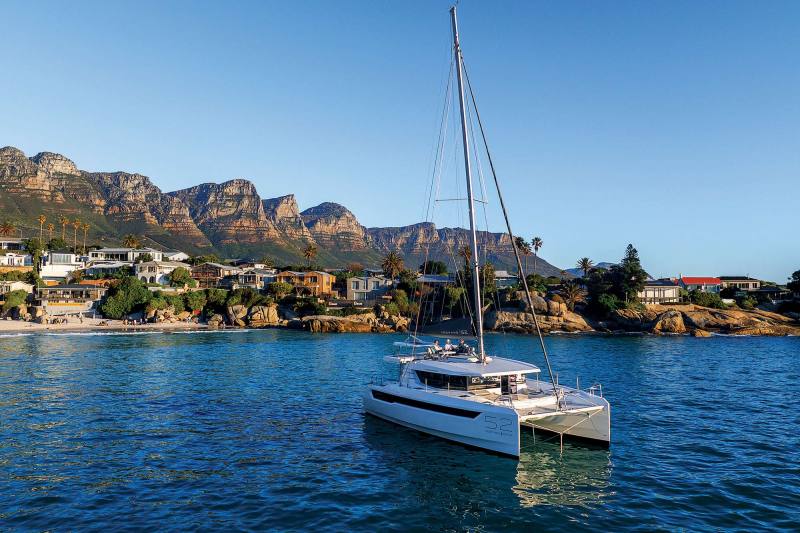 At anchor, the hybrid-powered 52 can lean on its quartet of 400-watt rooftop solar panels and 27-kWh lithium battery bank, while the flybridge lounge becomes the best seat in the house.
Courtesy Leopard
At anchor, the hybrid-powered 52 can lean on its quartet of 400-watt rooftop solar panels and 27-kWh lithium battery bank, while the flybridge lounge becomes the best seat in the house.
Courtesy Leopard
Success in the marine industry is often spawned by close and longstanding collaborative efforts. Builder Frank Butler and engineer Gerry Douglas made magic at Catalina Yachts for decades. Designers Rod Johnstone and his son, Alan, have never created a slow J/Boat. The Harken brothers, Peter and Olaf, helped start a revolution in sailboat hardware. Likewise, in the realm of cruising and charter catamarans, few have had the influence of Franck Bauguil, who heads up the product-development branch of Leopard Catamarans and The Moorings charter operations, and naval architect Alex Simonis, who channels Bauguil’s visions into oceangoing realities. Aiding and abetting the pair is the South African builder Robertson and Caine, which has produced almost 4,000 Leopard-branded cats.
Their latest mutual effort is the Leopard 52 (aka the Moorings 5200), which was introduced in the United States last fall and has been nominated for the 2026 Boat of the Year awards. For the purposes of this review, we’ll focus on the Leopard version, which has a terrific portside owner’s stateroom and is offered with a nifty and highly developed hybrid propulsion system (the Moorings vacation model has a five-or six-stateroom layout and no hybrid option). The creators have touted the Leopard 52 as “the most versatile catamaran in its class,” and it would be hard to argue otherwise.
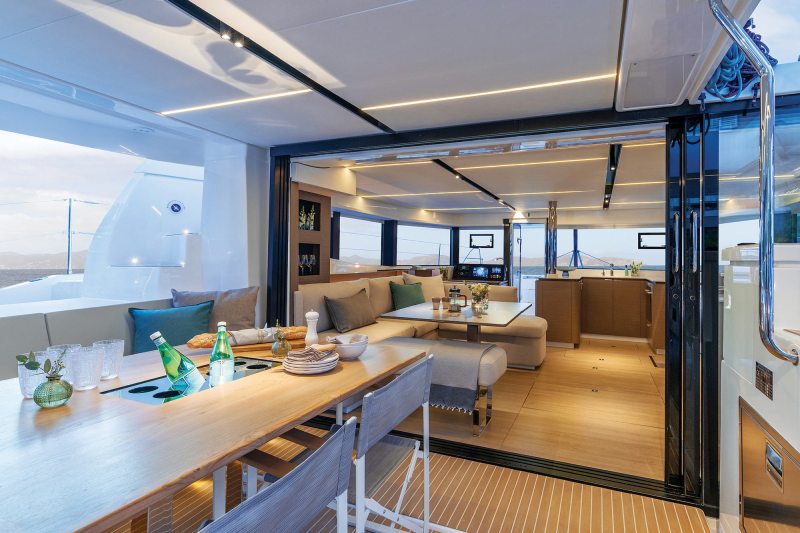 Forward and cockpit doors open to a single connected floor plan flooded with light from 360-degree glass windows.
Courtesy Leopard
Forward and cockpit doors open to a single connected floor plan flooded with light from 360-degree glass windows.
Courtesy Leopard
In appearance, form and function, the 52 is unquestionably a Leopard cat. In profile, the aesthetics mirror the familiar Leopard DNA: a plumb bow, forward cockpit, massive freeboard, distinctive hull windows and pronounced reverse transom with built-in steps to facilitate swimming and boarding.
Matters become more interesting as you ascend from deck level to the flybridge. The raised steering station, to starboard, offers expansive views; is at the center of a suite of winches, clutches and running rigging for efficient singlehanding; and is capped by its own hard, protective Bimini top. With a quick glance to port, the helmsman is at eye level with the guests lounging on the flybridge/sundeck, accessed by its own dedicated staircase, and with a low-slung, L-shaped settee. The upper deck also serves as the solid roof over the cockpit, and as the platform for an integrated quartet of 400-watt solar panels.
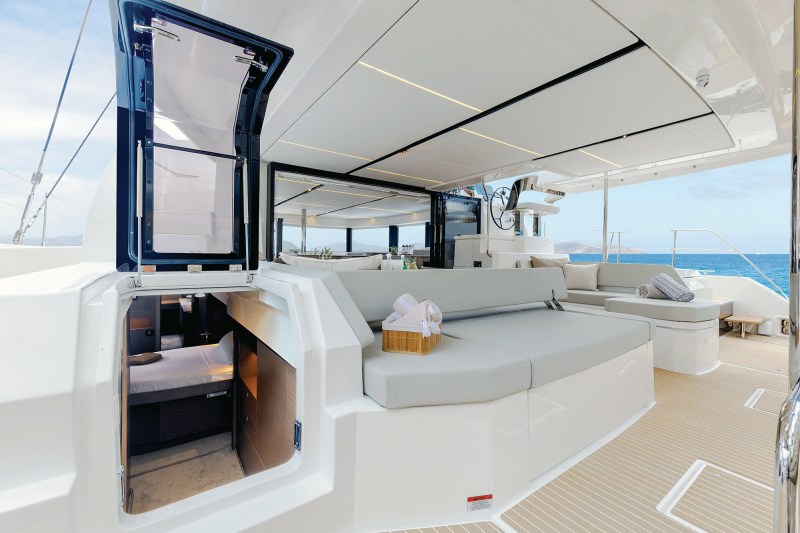 The cockpit area is thoughtfully conceived for life on the water.
Courtesy Leopard
The cockpit area is thoughtfully conceived for life on the water.
Courtesy Leopard
Energy efficiency, particularly in the hybrid setup on our test boat, is a recurring theme. (The boat is also available with a pair of 57 hp Yanmar diesel engines that can be upgraded to 80 hp.) The dual hybrid package carries a pair of 25-kW electric motors and a 27-kWh lithium battery bank that runs at 400 volts and that works in tandem with a Joool OneBox energy management system that controls the various voltages and frequencies. Otherwise, the boat runs on standard 12-volt DC and 110/240-volt AC with conventional inverters and converters. There’s also a 24-kW generator (a so-called “range extender”) that allows pure electric motoring; power regeneration is possible under sail. Our test boat, with the electric-drive option, came in at $1.4 million (about $200,000 more than with the Yanmar auxiliaries alone).
Robertson and Caine have earned their considerable reputation by building strong offshore sailboats. The 52 is constructed with a series of fiberglass ring frames and a structural cross-linked foam core that’s vacuum-infused in a laminate that employs E-glass and modified polyester resin. “The hulls and the bridge deck are now infused in a single shot,” Simonis said, “which means there’s no longer a centerline joint visible on the finished boat. That’s a significant achievement because the centerline split in the mold was always the most difficult part of the infusion process to make airtight.”
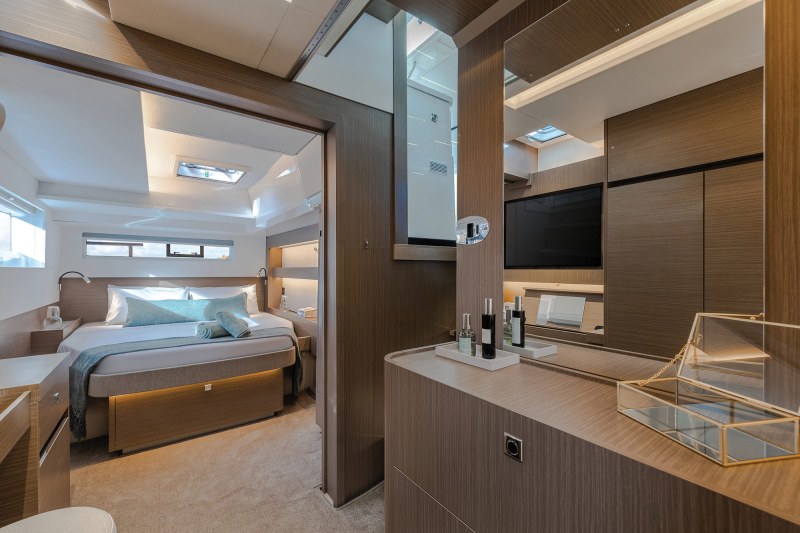 The three-stateroom layout anchors on a full-length owner’s stateroom.
Courtesy Leopard
The three-stateroom layout anchors on a full-length owner’s stateroom.
Courtesy Leopard
On the main deck level, with the forward and cockpit doors open, the floor plan is impressive. In the main saloon, natural light flows through the glass coachroof windows that allow 360-degree views. The dedicated navigation station is adjacent to the forward-facing galley that includes full-size appliances such as a dishwasher and an induction stovetop. The dining table is to port, wrapped around an inviting U-shaped settee (a second dining area is in the cockpit). There’s no need to limit the guests at this Leopard party.
Our test ride was laid out with what the company refers to as the “ultimate liveaboard” three-stateroom arrangement. There’s the aforementioned owner’s stateroom; a VIP and a guest stateroom aft that can be accessed from its own companionway. This layout also includes a utility room forward to port with a workspace, a washing machine, the watermaker, and room for storing tools and spares. It would be hard to find a more comfortable all-around arrangement in 52 feet.
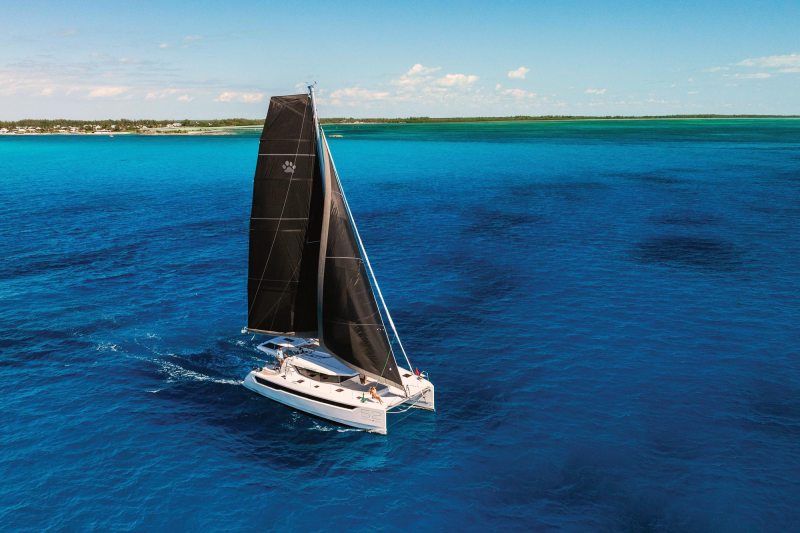 The Leopard 52 wears the brand’s familiar DNA: plumb bows, a forward cockpit, high freeboard, signature hull windows, and a pronounced reverse transom with built-in steps for swimming and boarding.
Courtesy Leopard
The Leopard 52 wears the brand’s familiar DNA: plumb bows, a forward cockpit, high freeboard, signature hull windows, and a pronounced reverse transom with built-in steps for swimming and boarding.
Courtesy Leopard
Due to time constraints, we tested the boat on a nasty Chesapeake Bay afternoon in what was basically a cold nor’easter with gusts in the mid-20s. In retrospect, going with the full square-topped, carbon mainsail was an aggressive call. Still, the boat performed admirably, making 6 knots upwind and on a broad reach. There was no doubt the boat could handle just about anything Mother Nature dished out.
I’ll hope to score another ride on the Leopard 52 in more benign weather. What I’m really hoping to test is that lounge deck, stretched out with a cold one in hand.
The post Leopard 52 Review: The Most Versatile Cat in Its Class appeared first on Cruising World.