Racing Into the Crystal Ball
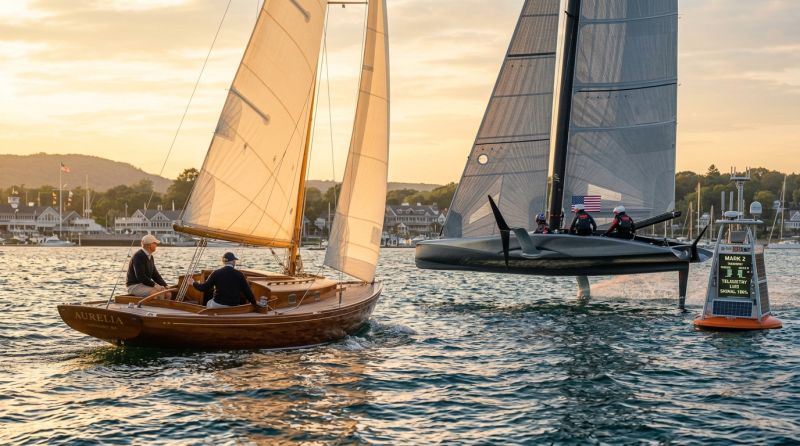 More foiling and more classic yachting are in our future says Gary Jobson. And handicap rules that keep designers guessing.
AI generated by Adobe Firefly
More foiling and more classic yachting are in our future says Gary Jobson. And handicap rules that keep designers guessing.
AI generated by Adobe Firefly
Twenty-five years ago—oh, how time flies—I was inspired to write a column for Sailing World that looked toward the future. The title of my piece was, “On the Wind in 2025” (published February 2001). I recently cracked open the article as if it were a buried time capsule and discovered that I was spot on with a few prognostications, and a bit off course on others. But the obvious question I came away with was, “OK, so where will the sport of sailing be 25 years from now?”
My somewhat accurate forecasts from 2025 included sensors on the bow for the race committee to determine if a boat is OCS. We’re certainly there. Next was that America’s Cup yachts would be using mast foils and higher tech keels — a harbinger of foiling monohulls. I also predicted that race crews would improve their skills by putting in long hours on simulators, that sailing would become a big-time league sport (SailGP) and that sailors would wear head coverings (helmets).
Heck, I even wrote that the price of gasoline would be over $5 per gallon. Sorry about that.
Back in 2021, however, I did not foresee the increased use of Artificial Intelligence and the proliferation of foiling sailboats. Today, five of the ten Olympic classes are foiling. I did not see that coming. Win some lose some.
So, now where are we going? Let’s fast forward through the next couple of decades.
The rise of computerized sailing takes away the skills needed for reading the wind on the water and tactical calls simply come out of a computer, so the sailors stage a revolt and revert to old-school racing with minimal instruments and computers. The emphasis returns to the skill of the sailor making the decisions without the assistance of AI.
The Velocity Prediction Program developed by the Pratt Project in 1970, which is the basis of most handicap rating rules, undergoes rapid permutations because AI allows designers to exploit new areas with ease. Frustration grows to the point that handicap fleets shrink exponentially and custom raceboat building comes to a halt. In an effort to turn the tide and modernize handicap ratings systems, a group of frustrated owners commission a consortium of naval architecture colleges including M.I.T., the University of Michigan and the U.S. Naval Academy to study the problem. With the aid of super-computers and AI, a whole new handicap rating system is developed after the known performance numbers of all racing boats is analyzed. It takes a year and several million dollars to fund the research project.
In the end, two handicap systems are adopted. The first is an empirical rule that is updated every month based on time differences of the boats and classes being raced. PHRF, which was the rule used in 2026, is improved by real-time churning results from across the country to periodically re-calculate the handicap ratings. The second new handicap rule is far more sophisticated, and consequently, far more accurate. This grand-prix handicap rule is difficult for yacht designers to exploit as it is updated annually based on actual results. The new rules abandon the use of incorporating wind velocity as a rating factor because it is too difficult to determine an accurate wind strength across a long-distance racecourse.
Grassroots one-design sailing grows thanks to initiatives of yacht clubs and community sailing programs that acquire fleets of utilitarian boats for racing and lessons. Sailors with busy careers and lives can race in shorter time frames because the boats are provided and maintained by staff. Robotic marks are deployed straight from the dock and autonomously adjust course lengths to keep races running efficiently. Yacht clubs collaborate with each other to commission new designs that are fun to race and easier to maintain and store using lightweight recycled materials. Intercollegiate sailors that once disappeared from the sport after graduating have an easy way to continue sailing because team racing is universally accepted and practiced around the country.
Sea level rise impacts every coastal community, marina and yacht club, so almost all facilities use floating modular docks to alleviate the problem. Most aging club buildings are raised, utilizing parking beneath the structure, which allows more property space for drysail storage. Consequently, small-boat sailing grows in popularity. The cost of fuel continues to rise, inspiring people to look at sailing as a less costly alternative to boating. The old expression, “The wind is free, use it” returns to favor.
The International Olympic Committee takes a hard look at sailing and reviews the viewership decline of the broadcast audience. World Sailing conducts studies to determine what format, and discipline would attract greater attention. The studies show that foiling craft are speedy but are difficult for spectators and viewers to follow. Two-versus-two team racing, a long- distance race and new classes of fast one-design boats and coed crews across all disciplines makes the Olympics more compelling for viewers. The study determines that close racing, lead changes, and colorful personalities are the ingredients for better visibility and interest.
The thriving classic yacht racing scene enjoys another renaissance. Wooden vessels built 50 and even 100 years earlier undergo renovations as owners and caretakes continue to pay forward their appreciation—and their wallets—to ensure their classic yachts endure. Many of the wooden vessels built between the early 1900s through the 1950s remain still active.
When I first started sailing in the mid 1950s boats were built of wood, cotton sails were just being replaced with Dacron, and fiberglass was a thing of the future. Innovations, such as the use of carbon fiber, breathable foul weather gear, the Internet, GPS, gyro binoculars, cell phones, weather routing and even sailing on television were science fiction dreams of the future. It’s amazing that all of these things are common today. I’m sure we will continue to see many fascinating new developments in boats, equipment, sails, communications, instruments and computers. But one thing will not change and that is the simple joy of spending time on the water with family and friends. The freedom of being away from land to enjoy the environment and the ever-changing weather and water. That is the essence of the sport no matter how advanced it becomes.
The post Racing Into the Crystal Ball appeared first on Sailing World.