Navio Lento: The Case for Sailing Slowly
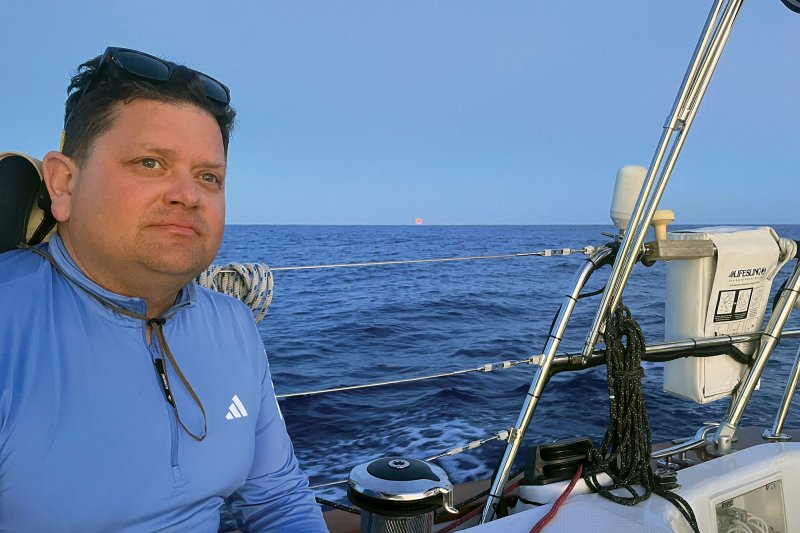 Anderson Noel, equally comfortable on a ship’s bridge or a cruising sailboat, takes in the full moon rising in the North Atlantic.
Herb McCormick
The first time Anderson Noel heard the term, on the bridge of a Portuguese tanker in the midst of operations that had just gone sideways, the ship’s pilot was hollering it repeatedly while frantically trying to get matters back under control. “Navio lento! Navio lento!” Only later did he learn the translation: slow ahead.
“At the time, I didn’t know what it meant, just that it seemed appropriate,” he said. It struck such a resounding chord that, when Noel was conjuring a name for the Gulfstar 44 he’s been diligently fitting out for extended high-latitude cruising, he already had the perfect one: Navio Lento. Now that, I thought, was one cool handle.
Noel was recounting this tale in a shoreside Bermudan marina last spring after we’d shared crewing duties aboard the Tayana 52 Moonstone, in the just-concluded Antigua Bermuda Race. Noel is the rare Canadian in the ranks of the Cruising Club of America, which is how he’d hooked up with Moonstone skipper and fellow CCA member Jay Gowell.
I’d thoroughly enjoyed sailing with him, a natural, fantastic sailor and professional merchant seaman. I’d never sailed with a ship’s captain before, and I was always curious about how the pros assessed us small-boat sailors. He had a pretty humorous anecdote to share.
“A British master I sailed with called me a ‘waffie’ for a couple of days,” he said. “When I asked what it meant, he said, ‘wind-assisted f’ing idiot.’ At first, I wasn’t sure how to take it, but I eventually shrugged it off and took it as a compliment. In his mind, you’d have to be nuts rolling around on a small sailboat in the middle of the ocean. In my mind, it’s not a bad place to be.”
Still, I wondered if his merchant ship experience was translatable to ocean sailing, or vice versa.
“I think they’re symbiotic,” he said. “Basic marine professions—navigation, communications, how you manage a vessel at sea—apply equally to a small sailboat and a large ship. The bigger ships carry a higher level of machinery and technology, so the maintenance requirements are far more advanced than in yachting. But that knowledge helps enormously when dealing with the yachting space.
“And the small-boat experience gives you a very different view of navigation when you’re on a bigger vessel. Merchant officers who haven’t sailed often find sailboats perplexing on radar—they don’t know what the vessel is going to do. In close-quarter situations, unless you understand points of sail and normal sailing behavior, you tend to be skittish. Equally, sailors can be skittish around large commercial vessels. If you understand both sides—what’s happening on the bridge versus what’s happening in the cockpit—you have a lot more comfort and situational awareness.”
Noel grew up in Newfoundland and started sailing as a kid in the family’s Tanzer 22. His parents later found a note he’d scribbled in the first grade: “When I grow up, I want to be a first mate.” After receiving his maritime education at the Maritime Institute in St. John’s, Newfoundland, he started off on a tanker delivering fuel to the Arctic; joined the Canadian Coast Guard, rising through the ranks to chief officer; and eventually returned to the private sector. He surpassed those first-mate aspirations by a long shot.
Meanwhile, he was racing and cruising as much as possible, simultaneously becoming the commodore of the Royal Newfoundland Yacht Club, first with a C&C 37 and now with his Gulfstar. Eventually, he hopes to sail via “the Viking route” to Greenland, Iceland and on to Scotland, Scandinavia and into the Mediterranean. “I’d call it a five-year goal, but realistically it’s probably closer to a 10-year goal, because any of this will have to be accomplished by leaving the boat for periods of time to work.”
As that Portuguese pilot left an impression on Noel, I’d have to say sailing with Noel rubbed off on me. As for “slow ahead,” it seems like not only a pretty strong strategy for cruising sailors and for maneuvering out of a tight spot, but for living life, as well.
The post Navio Lento: The Case for Sailing Slowly appeared first on Cruising World.