Maritimo M50 Reviewed
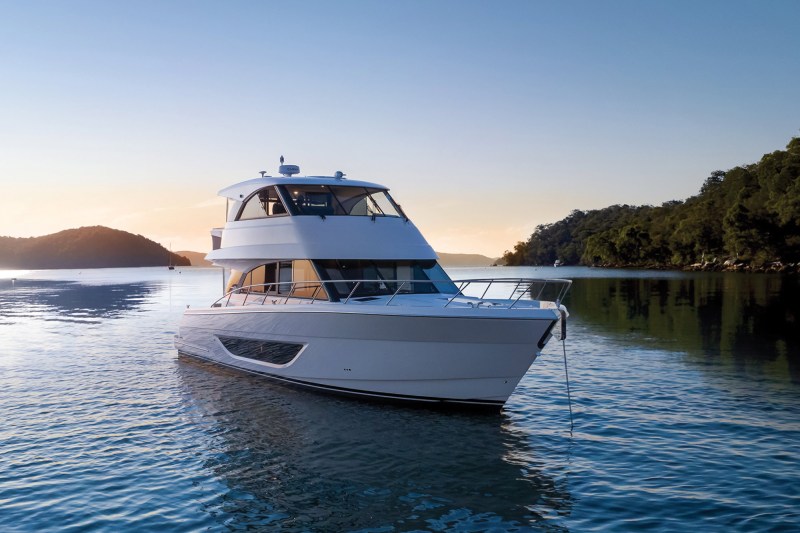 The Maritimo M50 enclosed-bridge yacht is purpose-built for extended cruising.
Courtesy Maritimo
Before founding Maritimo in 2003, Bill Barry-Cotter was a competitive sailor and an offshore powerboat racer. In that world, where reliability matters as much as speed, the hulls, engines and systems are pushed to their limits over hundreds of miles of unforgiving ocean. Failures carry serious consequences.
That experience shaped the build philosophy for every Maritimo that followed. The company embraced a mission to produce yachts capable of traveling long distances comfortably, efficiently and, above all, dependably.
Those principles were evident on the M50 during a summer run off Fort Lauderdale, Florida, where the Atlantic served up conditions that serious cruisers know well. A persistent 10- to 15-knot breeze roiled the Gulf Stream into confused 2- to 4-foot seas topped by a stiff wind chop; a few much larger swells were thrown into the mix. It wasn’t uncomfortable enough to keep boats like the M50 in port, but it was the kind of day that can expose shortcuts in design and construction.
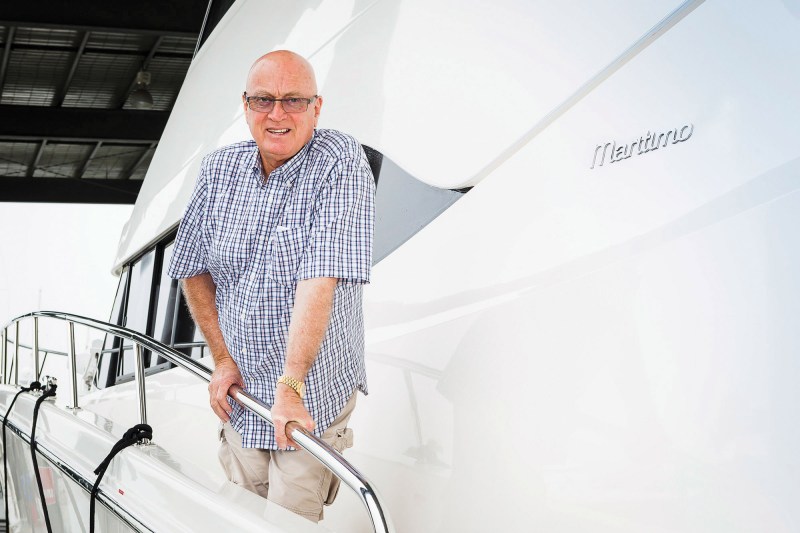 Maritimo founder Bill Barry-Cotter embraces dependability and solid engineering.
Courtesy Maritimo
The M50 is designed for owners who are trading up from express cruisers and flybridge boats in the 40- to 45-foot range. They want more living space, improved comfort and greater range. Maritimo’s answer is a yacht that feels purpose-built for extended cruising.
At first glance, the enclosed-bridge cruiser checks many boxes for the buyer of a luxury motoryacht. There’s satin-finished woodwork, expansive windows, contemporary furnishings and premium electronics. Spend more time aboard, though, and the details reveal themselves. Doors swing on oversized hinges. Manual mechanisms replace electric motors wherever practical. Stowage seems to be everywhere, and access to engines and systems is straightforward.
One of the most successful aspects of the design is the galley-aft arrangement. Here, the galley connects with the salon and the cockpit, functioning as a social hub while making meal prep and delivery easy. More important, the galley reflects how owners actually use their boats. Refrigeration and freezer capacities are generous, while cabinetry provides room for provisions measured in weeks rather than days. Long-range cruising isn’t just about fuel capacity; it’s about carrying enough food, drinks and supplies to remain comfortably independent. The Maritimo M50 is outfitted for that reality.
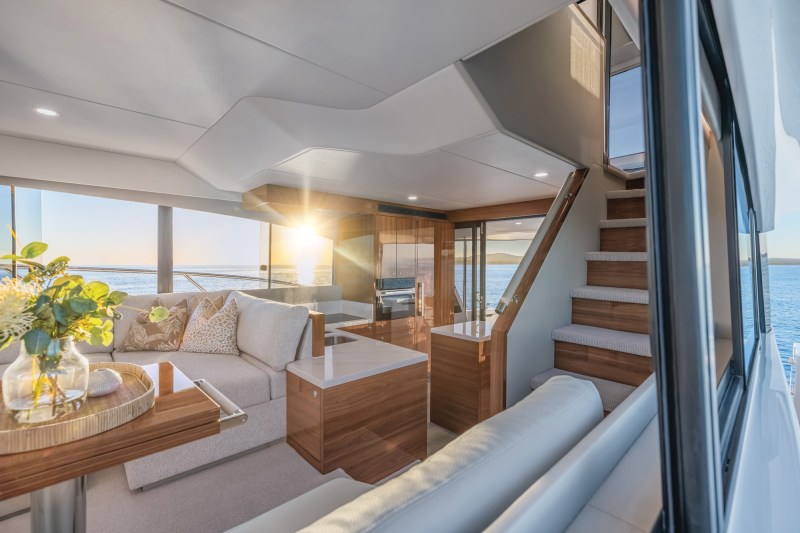 The galley connects with the salon and the cockpit, functioning as a social hub while making meal prep and delivery easy.
Courtesy Maritimo
In the salon, an L-shape lounge to port faces a U-shape dinette to starboard. The starboard settee also converts to a pullout berth for guests or grandchildren. The television reflects Maritimo’s practical build philosophy. It’s not set on an electric lift. Instead, the display flips up manually from a hidden cabinet. This simple mechanism is easy to operate and less susceptible to failure.
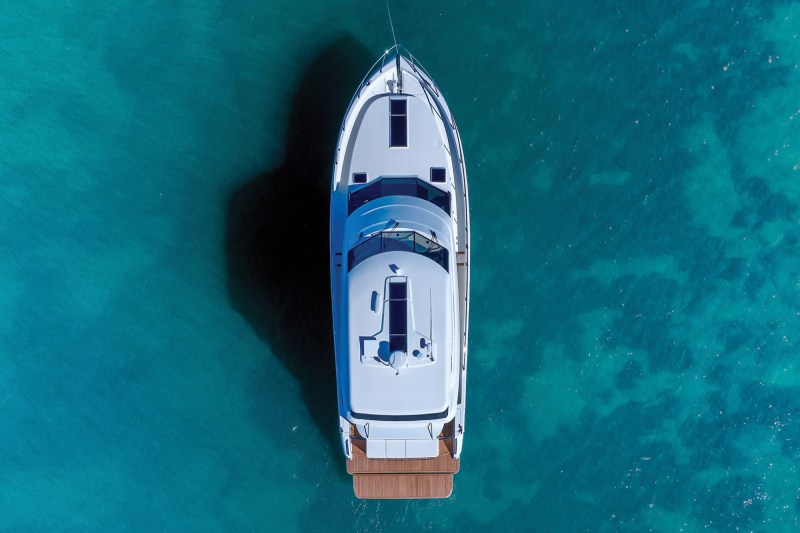
Another clever feature is the optional hydraulic swim platform. It lowers below the water’s surface to launch a tender or personal watercraft, and pivots up into a near-vertical position behind the transom for tying up in a tight slip.
Inside, the M50’s accommodations emphasize comfort. The forward VIP stateroom is five steps below the salon. It has a mechanically adjustable queen berth that separates into twin berths with the flip of a lever. With no electric motor, there’s no hidden switch to locate. This is straightforward engineering that’s unlikely to create a frustrating maintenance issue. The berth is also positioned to maximize walkaround space and makes the stateroom feel larger than similar spaces on yachts in the same size range. The adjacent day head serves the VIP.
 The optional Seakeeper Ride interceptors work quietly in the background to minimize roll and improve trim.
Courtesy Maritimo
Three steps down and aft is the full-beam owner’s stateroom, which occupies the beamiest portion of the hull. With 6 feet, 4 inches of headroom and generous hullside windows, it feels appropriately spacious for a cruising yacht that can spend weeks away from its home port. The en suite includes a separate glass shower that adds a residential touch.
The enclosed bridge is one of Maritimo’s defining features. An internal staircase leads from the salon to the helm. A pair of adjustable, automotive-style captain’s chairs provides comfortable seating during long passages, while three 19-inch Garmin multifunction displays dominate the dash. Another thoughtful touch is the electrical panel, which is positioned at eye level beside the staircase. Rather than force the operator to crouch down and peer into a locker, this panel makes it easy to inspect and access breakers.
Sliding doors open onto the bridge deck aft, where loose furniture creates an outdoor seating area overlooking the cockpit. Like the rest of the boat, this space is practical without sacrificing comfort.
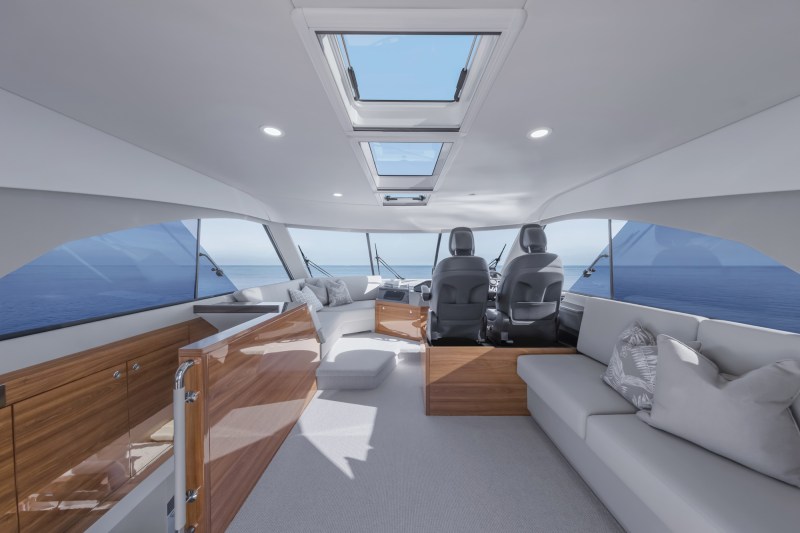 The enclosed bridge with an internal staircase that leads to the salon is one of the defining features of the M50.
Courtesy Maritimo
Propulsion follows the same philosophy. The M50 uses conventional straight shafts powered by twin Volvo Penta D13 diesels producing 800 horsepower each. Experienced cruisers respect straight-shaft propulsion for its durability, mechanical simplicity and easy maintenance. Maritimo pairs the shafts with proportional Vetus bow and stern thrusters operated via joystick for easier docking.
The boat I was aboard was equipped with optional Seakeeper Ride interceptors, which worked quietly in the background to minimize roll and improve trim. The system sharpened a capable hull, allowing the yacht to maintain comfortable progress through the mixed sea state without excessive bow rise or pounding.
Maritimo reports a top speed of 30 knots. We recorded 28.6 knots at wide-open throttle, validating the builder’s performance claims given the day’s conditions and the vessel load. More meaningful numbers for most owners are cruise speed and range. At 2,120 rpm and 80 percent engine load, the M50 settled comfortably into a 22-knot cruise while burning roughly 65 gallons per hour for a range of 282 miles between fuel stops with a 10 percent safety reserve. Throttle back, and the yacht reveals its passagemaking chops. At 7.5 knots, fuel burn dropped to just 6.5 gallons per hour.
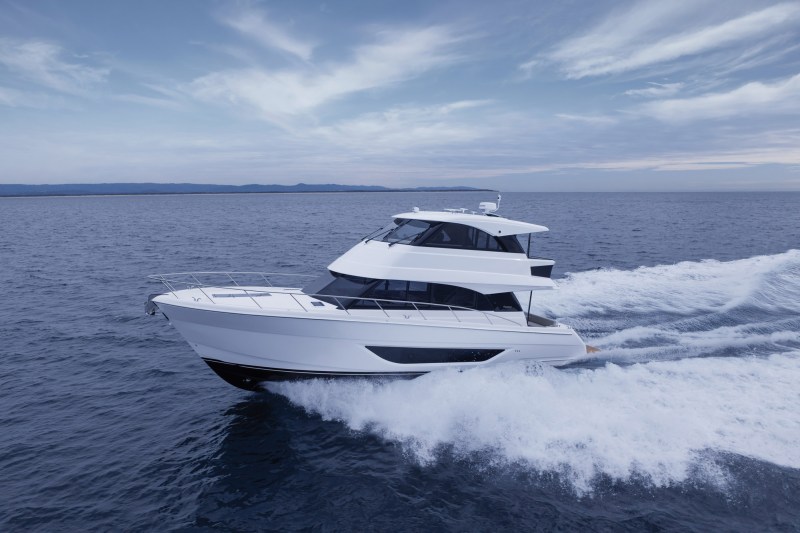 The M50 uses conventional straight shafts powered by twin Volvo Penta D13 diesels producing 800 horsepower each.
Courtesy Maritimo
Even more impressive were the sound levels. Running at displacement speed, we measured just 63 decibels at the helm. Long cruising days are considerably less fatiguing when conversation doesn’t require raised voices.
The M50’s greatest accomplishment may be that it doesn’t try too hard to impress. Experienced cruisers will notice things like easy access to machinery, stowage volume, sturdy hardware, fuel economy, hull efficiency and systems they can understand when they are hundreds of miles from the nearest service tech. The M50 is designed by people who understand those priorities.
Smooth OperatorUnlike traditional trim tabs, Seakeeper Ride uses rotary blade interceptors mounted at the transom to make hundreds of automatic adjustments every second. Sensors continuously monitor the boat’s pitch and roll, deploying the blades independently to improve trim, reduce bow rise during acceleration, and minimize roll while underway. During my time on board, the M50 remained level and composed. The Seakeeper Ride is a good option for owners planning long offshore passages.
The Aussie WayAustralian boatbuilders like Maritimo design with distance in mind. Boating in Australia often involves long open-ocean passages and rapidly changing weather. The M50 reflects that heritage. Its substantial construction, conventional straight-shaft propulsion, abundant stowage and emphasis on mechanical reliability all prioritize dependable operation over complexity.
Take the next step: maritimoamericas.com
The post Maritimo M50 Reviewed appeared first on Yachting.